
Products >> Chlorine Liquefaction Refill Cylinder Line >> Chlorine liquefaction production line
Liquid chlorine is a basic chemical raw material that participates in various chemical reactions after gasification, with extremely wide applications:
- Metallurgical Industry: Used in the refining of rare metals such as titanium and magnesium.
- Organic Chemical Industry: An important raw material for the synthesis of polyvinyl chloride, plastics, pesticides, detergents, epichlorohydrin, chloroacetic acid, and other products.
- Inorganic Chemical Industry: Used in the production of inorganic chemicals such as sodium hypochlorite, ferric chloride, bleaching powder, and aluminum trichloride.
- Water Treatment: Used as a strong oxidant for the disinfection and purification of tap water and for the treatment of industrial wastewater.
- Textile and Paper Industry: Used in the bleaching process of textiles and paper.
Advantages:
|
Operational efficiency |
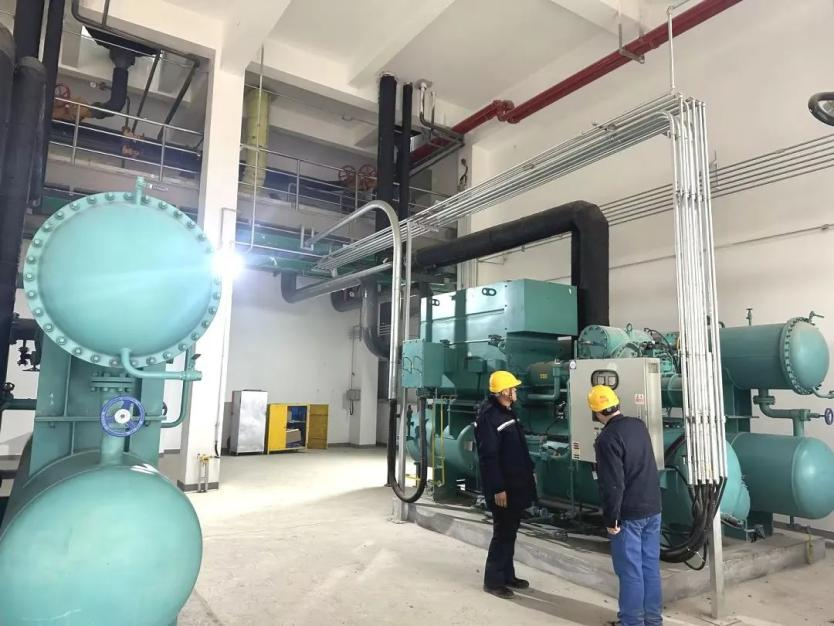
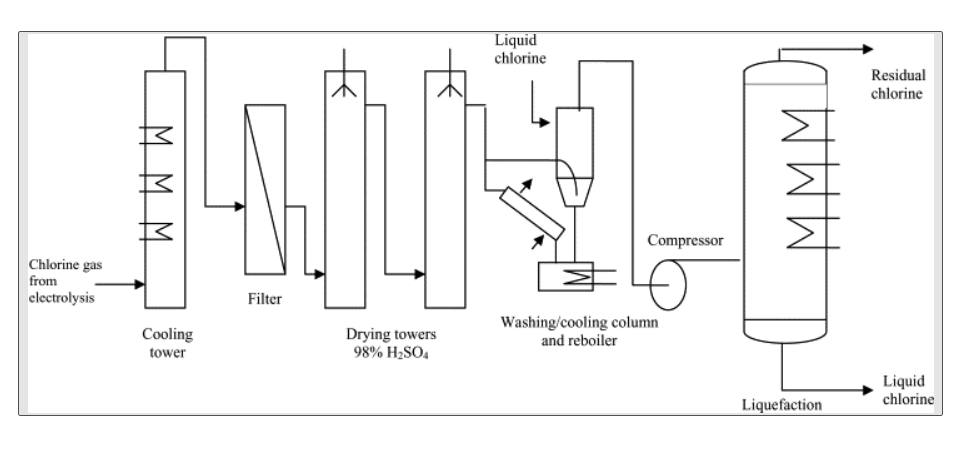
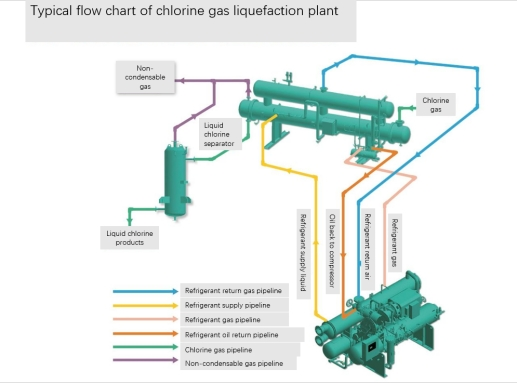
1.1 Energy Consumption Reduction Due to Advanced Technology: Traditional liquid chlorine production mainly involves low-pressure, medium-pressure, and high-pressure methods. Among them, the high-temperature, high-pressure method is considered a more energy-efficient and environmentally friendly clean production process. Compared to the low-pressure method, which requires deep freezing, the high-pressure method utilizes increased pressure (1.4~1.6MPa) to liquefy chlorine gas at ambient temperatures of 30~50℃, eliminating the need for a large refrigeration system. Therefore, it has the shortest process, simplest operation, and lowest overall energy consumption. Studies have shown that its comprehensive economic and environmental benefits are significant, making it an ideal choice for enterprises producing liquid chlorine products. 1.2 High Performance of Core Equipment: The core of a liquid chlorine production line is the chlorine liquefaction unit. Taking the economizer screw-type chlorine liquefaction unit as an example, its advantages are very prominent: l High Efficiency and Energy Saving: Compared to the old-fashioned reciprocating compressor, this unit has higher refrigeration efficiency and significant energy-saving effects. Data shows that using a screw-type unit compared to a reciprocating unit can save approximately 290,000 yuan in electricity costs annually (based on historical data). l Stable and Reliable: The unit operates smoothly, occupies a small area, and is easy to maintain. l Precise control and automation: Advanced units such as the YCL chlorine liquefaction unit are equipped with adjustable expansion valves and automatic liquid level control systems, which can automatically adjust according to production load to achieve fully automatic unattended operation. This not only makes operation convenient but also ensures continuous and stable performance. |
|
Security Guarantee: Multiple Protection Designs |
2.1 Intrinsic Safety Design of Equipment: l Corrosion Prevention: Liquid chlorine is highly corrosive to equipment. High-quality liquefiers use high-efficiency carbon steel bright heat exchange tubes, significantly reducing the risk of corrosion. l Leakage Prevention: The heat exchange tubes and tube sheet employ a double-layer protection system of slotted expansion joint + sealing welding, ensuring excellent sealing performance and effectively extending equipment lifespan. 2.3 Non-Stop Maintenance: Key components such as safety valves utilize a dual-safety-valve design, allowing customers to perform online replacement and annual inspections of safety valves without affecting production. 2.4 Process Safety Control: 2.4.1 Prevention of Chemical Reactions: The unit uses stable halogenated hydrocarbon refrigerants that do not react chemically with chlorine, eliminating the risk of reaction at the source. 2.4.2 Explosion-Proof Control: The hydrogen content in chlorine is a major hazard. The production line controls liquefaction efficiency (typically around 90%) to ensure that the hydrogen content in the exhaust gas is below the lower explosive limit of 4%. Simultaneously, the system monitors the hydrogen content in chlorine in real time, triggering an alarm or chain reaction if it exceeds the limit. |
|
Environmental Protection and Adaptability: Design for the Future |
3.1 Environmentally Friendly: The application of clean production processes such as high-temperature and high-pressure methods reduces the environmental footprint of the production process, meeting the environmental protection requirements of modern industry. 3.2 Flexible Layout: Some advanced unit control boxes feature rainproof designs and are equipped with refrigerant backflow prevention devices, fully meeting the requirements for outdoor open-air layouts and saving on plant construction costs. 3.3 Convenient Operation: The equipment is designed with user-friendliness in mind, typically concentrating control boxes, control valves, level gauges, and sight glasses on the same side, greatly facilitating daily inspections and maintenance by operators. |
In summary, a superior liquid chlorine production line usually combines energy-saving high-temperature and high-pressure processes with efficient and stable screw liquefaction units, while incorporating sufficient safety redundancy designs in equipment details (such as dual safety valves and corrosion-resistant heat exchange tubes), and is equipped with a highly automated control system. This combination ensures efficient, economical, and environmentally friendly operation while guaranteeing safety.
Products Category
- 15% Sodium_Hypochlorite_Plant
- Chlor-alkali project
- Hydrochloric acid production line
- Ozone Generator
- Chlor-alkali plant membrane electrolysis
- Strong Alkaline Water generator Machine china
- Seawater Electro Chlorination System Package China UAE desalination
- on site chlorine gas generator china
- Chlorine_Dioxide_Generator
- Chlorine Liquefaction Refill Cylinder Line
- UV sterilization
- Online Chlorine Concentration Meter Gauge
- electrolytic seawater chlorine system
- Sodium_Hypochlorite_Generator (Salt Water)
- Automatic dosing system PAC PAM
- Hypochlorous Acid Anolyte Generator
- Medical grade Neutral Anolyte HOCL Generator
- Alkaline ionized water machine
Contact Us

Name: Diana
Tel: +86-15201328666
Mobile: +86-15201328666
E-mail: info@bluewaVv.com
Skype: +86-15201328666
WeChat: +8615201328666
Whatsapp: +8615201328666
Add: No. 101, Gaoxin Sixth Road, Jiangxia District, Wuhan City,HUBEI Province, CHINA
Branch: Office N.420D-C1 Tower Ajman,UAE


 Skype Chat
 WhatsApp
  Mail inquiry