
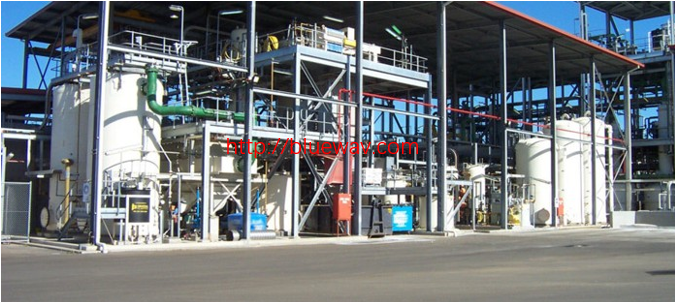
Products >> Sodium Hydroxide Generator detergent caustic soda plant NaOH
Features&Advantages
-
Less salt & electricity consumption
-
1ton.day-250ton.day capacity customized design
-
Salt purity requirement only NACL> 89% Less investment on salt
-
Local tech support at client site
-
Skid Mounted design Plug-Play
-
Automatic running system and safety control system by PLC
1.Chlor Alkali Plant technology Overview
The chlor-alkali industry is a basic chemical industry that electrolyzes saturated brine (NaCl) solutions while simultaneously producing caustic soda (sodium hydroxide), chlorine, and hydrogen. The complete sets of chlor-alkali equipment provided by our company use internationally advanced ion membrane electrolysis technology, featuring significant advantages such as low energy consumption, high product quality, and pollution-free operation, making them the mainstream technical route in the global chlor-alkali industry.
The complete unit can produce a variety of chlor-alkali products such as 15% sodium hypochlorite, 32%-50% caustic soda, tablet alkali (solid alkali), 31%-33% high-purity hydrochloric acid, liquid chlorine, and more. These products are widely used in alumina, chemical, papermaking, dyeing, water treatment, PVC production, pharmaceuticals, pesticides, and other industries.

2. System Process
2.1 Process Overview
This chlor-alkali production unit uses raw salt (NaCl) as the main raw material, employing zero-distance sub-membrane electrolyzers as the core equipment, and produces chlorine, hydrogen, and caustic soda through electrolysis of saturated brine. The entire system uses a DCS distributed control system for fully automated operation, ensuring a stable, safe, and efficient production process.
2.2 Main Process Units
The entire unit consists of the following core process units:
|
Serial number
|
Process unit
|
Explanation
|
|
1
|
Salt transformation and primary brine purification
|
After mixing raw salt with light brine water, saturated crude brine is used, and impurities such as Mg²⁺ and Ca²⁺ are removed through chemical precipitation
|
|
2
|
Secondary brine purification
|
A chelated resin tower is used to further remove calcium and magnesium ions, raising the impurity content to <20 ppb
|
|
3
|
Ion membrane electrolysis
|
The core process uses a cation exchange membrane electrolytic cell to electrolyze refined brine into chlorine, hydrogen, and caustic soda
|
|
4
|
Dechlorination/denitrification of light brine water
|
After electrolysis, the lightly brined water undergoes dechlorination and denitrification treatments before being reused in the salt transformation process
|
|
5
|
Chlorine gas treatment and liquefaction
|
Chlorine gas is cooled, dried, and compressed to produce liquid chlorine products
|
|
6
|
Hydrogen chloride synthesis and hydrochloric acid
|
After washing, cooling, and compressing hydrogen, it is used for hydrochloric acid synthesis or as fuel
|
|
7
|
Hydrogen chloride synthesis and hydrochloric acid
|
Hydrogen gas and tail chlorine are used to synthesize hydrogen chloride to produce 31%-33% high-purity hydrochloric acid
|
|
8
|
Preparation of sodium hypochlorite
|
Chlorine gas reacts with caustic soda to produce 15% sodium hypochlorite
|
|
9
|
Evaporation and alkali solidification
|
32% liquid alkali is concentrated by multi-effect evaporation to 50% liquid alkali, and further concentration can produce sheet alkali
|
3. Process flow
3.1 Main Process Flow
Raw salt→ Saltized salt → Primary brine purification → Secondary brine purification (chelated resin tower) → ion membrane electrolysis
Anode chamber: Cl⁻ discharge → chlorine gas (Cl₂) → cooling, drying, compression → liquid chlorine / hydrochloric acid / sodium hypochlorite
Cathode chamber: H⁺ discharge → hydrogen (H₂) → scrub compression → hydrochloric acid synthesis / fuel utilization
Cathode solution: NaOH solution → 32% caustic soda product → multi-effect evaporation → 50% caustic soda → concentrated flake → alkali

3.2 Principles of electrolysis reactions
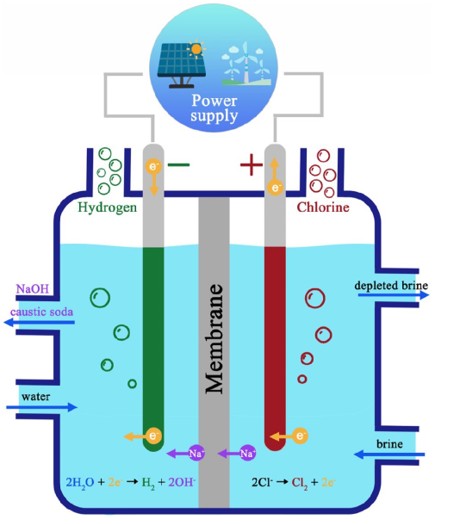
The ion membrane electrolysis method uses a cation exchange membrane to separate the anode chamber from the cathode chamber. The membrane has selective permeability, allowing only Na⁺ to pass through, while Cl⁻ and OH⁻ cannot pass through.
Overall reaction equation: 2NaCl + 2H₂O → 2NaOH + Cl₂↑ + H₂↑
Anode reaction: 2Cl⁻ - 2e⁻ → Cl₂↑
Cathode reaction:2H₂O + 2e⁻ → H₂↑ + 2OH⁻
Refined brine is injected into the anode chamber, and pure water is poured into the cathode chamber. During electrolysis, Na⁺ carries a small amount of water molecules through the ion membrane to migrate to the cathode chamber, where it combines with OH⁻ to form a NaOH solution.
3.3 Main Product Destinations
Chlorine gas: some are dried and compressed to produce liquid chlorine products; One part is used to synthesize hydrogen chloride with hydrogen to produce 31%-33% hydrochloric acid; Tail chlorine is used to react with caustic soda to produce 15% sodium hypochlorite
Caustic soda: can directly produce 32% ionized membrane caustic soda; Concentrated by multi-effect evaporation to 50% liquid alkali; Further concentration and tablet formation can produce flake alkali (solid base)
Hydrogen: Used for hydrochloric acid synthesis or as a clean fuel
4. Product specifications
|
Product name
|
Specification/concentration
|
Main uses
|
|
Sodium hypochlorite
|
15%
|
Disinfection, bleaching, and water treatment
|
|
Liquid alkali (caustic soda)
|
32%/50%
|
Alumina, chemicals, papermaking, dyeing and printing, water treatment
|
|
Tablet alkali (solid base)
|
Over 98%.
|
Chemical synthesis, metallurgy, pharmaceuticals
|
|
High-purity hydrochloric acid
|
31%-33%
|
Metal cleaning, chemical raw materials, acidizing treatment
|
|
Liquid chlorine
|
Over 99.5%.
|
PVC production, pesticides, pharmaceuticals, disinfection
|
|
Hydrogen
|
——
|
Supporting industries such as hydrochloric acid synthesis, combustion heating steam generation, hydrogen internal combustion engine/fuel cell power generation, ammonia synthesis, fine chemical hydrogenation, and metallurgy
|
5. Technical Advantages
5.1 Core Technical Advantages of the Ion Membrane Method
1. High product quality: Caustic soda has high purity and low salt content (50% NaOH contains only 50-60ppm of NaCl), meeting the quality requirements of high-purity caustic soda in high-end industries such as chemical fiber and pharmaceuticals.
2. Low energy consumption: The DC electricity consumption per ton of caustic soda is only approx.2000 kWh, significantly lower than the diaphragm and mercury methods.
3. No pollution: The ion membrane method does not produce mercury pollution (mercury process) or asbestos waste (membrane method), making it a green and environmentally friendly clean production technology.
4. High degree of automation: The entire device uses a DCS distributed control system, enabling full-process automatic control and stable and reliable operation.
5. High purity of chlorine and hydrogen: The product has high chlorine and hydrogen purity, which is beneficial for deep processing downstream utilization.
6. High current efficiency: current efficiency can reach 95%-96%, and the electrolyzer operates stably.
5.2 Technical Features of the Equipment
- Uses zero-pole distance sub-membrane electrolyzer technology to further reduce cell voltage and reduce energy consumption.
- The electrolyzer uses titanium anodes, carbon steel cathodes, and high-quality cation exchange membranes, offering strong corrosion resistance and long service life.
- Equipped with chlorine gas treatment and liquefaction systems to achieve efficient chlorine gas recovery and utilization.
- Utilizes multi-effect falling film evaporation technology, offering high thermal efficiency and low steam consumption.
- Key equipment materials are made of titanium, nickel, Hastelloy, and other corrosion-resistant materials to ensure long-term stable operation.
5.3 Customized Services
Customized designs can be provided according to customer production capacity requirements.
|
Item
|
Specification
|
|
Product
|
Sodium Hydroxide (NaOH),HCL,
Liquid Chlorine, sodium hypochlorite
|
|
Technology
|
Ionic Membrane Cell
|
|
Raw Material
|
Industrial, Salt/Brine
|
|
Capacity
|
Customized
|
|
NaOH Concentration
|
Customizable
|
|
Control System
|
PLC/Automation/DCS Control system
|
|
Power Supply
|
Based on project requirement
|
|
Installation
|
On-site/Turnkey
|
|
Certification
|
Available based on market
|
|
Application
|
Chemical manufacturing
|
6. Model Specifications
Ion membrane electrolyzer series
|
Model
|
Effective electrode area
|
Operating current density
|
Maximum allowable current density
|
Cyclic method
|
Fastening method
|
|
BSH-H
|
2.7m²
|
4.5-5.5kA/m²
|
6kA/m²
|
A natural cycle
|
Hydraulic/screw fastening
|
|
BSH-H
|
2.9m²
|
4.5-5.5kA/m²
|
6kA/m²
|
A natural cycle
|
Screw fastening
|
Main equipment configuration (taking a 100,000-ton caustic soda unit with an annual output as an example)
|
Equipment name
|
Specifications
|
Material
|
Note
|
|
Ion membrane electrolyzer
|
Effective area: 2.7-3.3m²
|
Titanium/nickel/ion membranes
|
Customization is available according to production capacity
|
|
A single brine filter
|
Customization
|
FRP/carbon steel liner
|
Refined with brine
|
|
Chelated resin tower
|
Three towers connected in series
|
Stainless steel
|
Secondary refining
|
|
Chlorine scrubbing cooling towers
|
Customization
|
PVC/FRP
|
Chlorine treatment
|
|
Chlorine compressors
|
Customization
|
Titanium material
|
Chlorine gas liquefaction
|
|
Multi-effect falling film evaporator
|
Third or fourth effect
|
Nickel-201
|
Alkaline solution concentration
|
|
Sheet alkali chip formation machine
|
Customization
|
Stainless steel
|
Alkali solidification production
|
|
Hydrochloric acid synthesis furnace
|
Customization
|
Graphite/carbon steel
|
High-purity hydrochloric acid production
|
|
Sodium hypochlorite reactor
|
Customization
|
Titanium/FRP
|
15% sodium hypochlorite production
|
|
DCS control system
|
Customization
|
—
|
Fully automated control throughout the process
|
7. Application Fields
|
Product
|
Main application industries
|
|
Caustic soda (32%-50% liquid alkali/flake soda)
|
Alumina smelting, papermaking, textile printing and dyeing, chemical synthesis, water treatment, soap and detergents
|
|
Liquid chlorine
|
PVC production, pesticides, pharmaceuticals, organochlorides, disinfection and sterilization
|
|
High-purity hydrochloric acid (31%-33%)
|
Metal cleaning, acid wells, chemical raw materials
|
|
Sodium hypochlorite (15%)
|
Disinfection, bleaching, and water treatment
|
8. Why choose us
Full-process solution: complete chlor-alkali equipment supply from brine refining to electrolysis, chloro-hydrogen treatment, and product refining.
Advanced technology: Adopts internationally mainstream zero-pole distance sub-membrane electrolysis technology, offering low energy consumption and high efficiency.
Customized services: We can provide customized designs based on customer production capacity requirements (10,000 tons/year ~ 1,000,000 tons/year).
High-quality materials: Key equipment uses corrosion-resistant materials such as titanium, nickel, and Hastelloy alloys to ensure long-term stable operation.
Automated control: Full-process DCS distributed control system is easy to operate, safe, and reliable.
Comprehensive after-sales service: We provide installation guidance, commissioning, training, and long-term technical support.
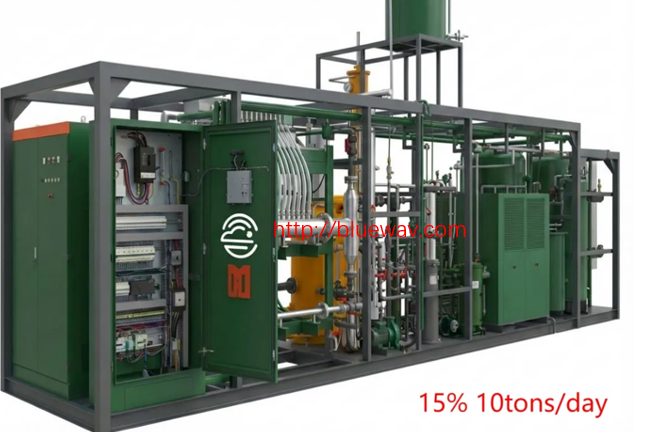
Note: The above equipment models and parameters are reference specifications; specific configurations can be customized according to customers' actual production capacity requirements. Welcome to call or write to us for detailed technical solutions.
BLUEWAV is the leading manufacturer of Chlor-Alkali plant EPC project in China with 20 years experiences.
Products Category
- 15% Sodium_Hypochlorite_Plant
- Sodium Hydroxide Generator detergent caustic soda plant NaOH
- Hydrochloric acid production line
- Ozone Generator
- Chlor-alkali plant membrane electrolysis
- Strong Alkaline Water generator Machine china
- Seawater Electro Chlorination System Package China UAE desalination
- on site chlorine gas generator china
- Chlorine_Dioxide_Generator
- Chlorine Liquefaction Refill Cylinder Line
- UV sterilization
- Online Chlorine Concentration Meter Gauge
- electrolytic seawater chlorine system
- Sodium_Hypochlorite_Generator (Salt Water)
- Automatic dosing system PAC PAM
- Hypochlorous Acid Anolyte Generator
- Medical grade Neutral Anolyte HOCL Generator
- Alkaline ionized water machine
Contact Us

Name: Diana
Tel: +86-15201328666
Mobile: +86-15201328666
E-mail: info@bluewaVv.com
Skype: +86-15201328666
WeChat: +8615201328666
Whatsapp: +8615201328666
Add: No. 101, Gaoxin Sixth Road, Jiangxia District, Wuhan City,HUBEI Province, CHINA
Branch: Office N.420D-C1 Tower Ajman,UAE


 Skype Chat
 WhatsApp
  Mail inquiry